Thursday, March 25, 2010

Solar eclipse


This is more or less how my review of Ian McEwan’s new novel Solar in Prospect started out (the final paras got a little garbled in the edit). I’m amused to see that my suggestion here that his modest intentions might head off extreme reactions has been proved wrong. Lorna Bradbury in the Telegraph calls the book McEwan’s best yet, and thinks it should win the Booker (no way). And some found the comic elements ‘extremely funny’. Others think it is a stinker: one reviewer calls it ‘an odd, desultory production, by turns pompous and feebly comic’, and Leo Robson in the New Statesman says McEwan has lost his ear and that ‘With Solar, McEwan has finally committed the folly that we might not have expected from him.’ Really, they are all getting too worked up. Although I wouldn’t go as far as the dismissive comment in the Economist that this is ‘A novel to chuckle over, and chuck away’, it is simply a fairly light, intelligent piece of entertainment. Not, I imagine, that McEwan will be too bothered about any of this.

***********************************************************************

After Saturday, which several reviewers considered (unfairly) to be an insufferably smug depiction of Blair’s Britain in the approach to the invasion of Iraq, it looked as though a place was being prepared for Ian McEwan alongside Martin Amis on the pillory. Our two most celebrated novelists, the story went, were getting above themselves, pronouncing on the state of the nation from what seemed an increasingly conservative position.

Amis seems now to be in some curious quantum superposition of states, defended in a backlash to the backlash while demonized as the misogynistic wicked godfather. His latest novel The Pregnant Widow has been both praised as a return to form and derided as a farrago of caricature and solipsism. But Solar may extricate McEwan from such controversies and reinvest him with the humble status of a storyteller. For the book is a modest entertainment, dare one even say a romp, and essentially a work of genre fiction: lab lit. This genre, a second cousin of the campus novel, draws its plots from the exploits of scientists and the scientific community, and includes such titles as Allegra Goodman’s Intuition and Jonathan Lethem’s As She Climbed Across the Table.

McEwan’s interest in science is well established. The protagonist of Enduring Love is a science journalist, and the plot of Saturday hinged on the technical expertise of its central character, the neuroscientist Henry Perowne. McEwan has spoken about the uses of science in fiction, and has written passionately about the need to tackle climate change.

And that is where Solar comes in. When McEwan mentioned at the Hay Festival in 2008 that his next book had a ‘climate change’ theme, people anticipated some eco-fable set in the melting Arctic. He quickly denied any intention to proselytize; climate change would ‘just be the background hum of the book.’

So it is. Michael Beard, a Nobel laureate physicist resting on the laurels of his seminal work in quantum physics decades ago, is balding, overweight, addictively philandering, and coming to the end of his fifth marriage. Like many Nobel winners he has long ceased any productive science and is now riding the superficial circuit of plenary lectures, honorary degrees, Royal Commissions and advisory boards. Becoming the figurehead of the National Centre for Renewable Energy, marooned near Reading, seemed a good idea at the time, but the centre’s research has become mired in Beard’s ill-advised notion of making a wind turbine. Beard is privately indifferent to the global-warming threat, but when a chance arrives to give his career fresh lustre with a new kind of solar power, he grasps it greedily. With Beard running more on bluster and past glory than on scientific insight, and with his domestic life on autodestruct, we know it will all end badly. The question is simply how long Beard can stay ahead of the game. As the climate-change debate moves from the denialism of the Bush years to Obama and Copenhagen, he is increasingly a desperate, steadily inflating cork borne on the tide.

As ever, McEwan has done his homework. Mercifully, he knows much more than Lethem about how physicists think and work. And he is more successful in concealing his research than he was with the neuroscience shoehorned into Saturday. But not always. Beard’s speech to a group of climate-sceptic corporate leaders reads more like a lecture than a description of one: “Fifty years ago we were putting thirteen billion metric tons of carbon dioxide into the atmosphere every year. That figure has almost doubled.” And when Beard debunks his business partner’s doubts about global warming after the cool years of the late noughties, he gets full marks for science but risks becoming his author’s mouthpiece. “The UN estimates that already a third of a million people a year are dying from climate change” is not the kind of thing anyone says to their friend.

In case you care, the solution to the energy crisis on offer here – the process of ‘artificial photosynthesis’ to split water into hydrogen and oxygen using photocatalysis – is entirely respectable scientifically, albeit hardly the revolutionary breakthrough it is made out to be. Much the same idea was used by Stephen Poliakoff in his 1996 lablit play Blinded By the Sun; McEwan’s clever trick here is to involve quantum-mechanical effects (based on Beard’s Nobel-winning theory) to improve the efficiency, which left the nerd in me wondering if McEwan was aware of recent theories invoking such effects in real photosynthesis. I’m not sure whether to be more impressed if he is or if he isn’t.

McEwan nods toward recent episodes in which science has collided with the world outside the lab. Beard’s off-the-cuff remarks about women in science replay the debacle that engulfed former Harvard president Larry Sumner in 2005, and Beard stands in for Steven Pinker in an ensuing debate on gender differences (although Pinker’s opponent Elizabeth Spelke did a far better demolition job than does Beard’s).

He also makes wry use of personal experience. When he read at Hay a draft of the episode in which Beard eats the crisps of a fellow traveller on a train, thinking they are his own and suppressing fury when the young man ironically helps himself, someone in the audience pointed out that a similar case of false accusation of an innocent stranger appeared in The Hitchhiker’s Guide to the Galaxy. Some newspapers made a weak jibe at plagiarism. When Beard recounts the tale in a speech, a lecturer in ‘urban studies and folklore’ accuses him of appropriating a well-known urban myth, making Beard feel that his life has been rendered inauthentic – and the allusion to Douglas Adams is now inserted in the story.

One of the pleasures for a science watcher is identifying the academics from whom Beard has been assembled – I counted at least five. He is a difficult character to place centre-stage, not just selfish, unfaithful and vain but also physically repulsive – McEwan is particularly good at evoking queasiness at Beard’s gluttony and bodily decrepitude. But he has said that he wanted to leave Beard just enough possibility of goodness to engender some sympathy, and he succeeds by a whisker. When the final collapse of Beard’s crumbling schemes arrives (you can see it coming all along), there is room for compassion, even dismay.

Solar is, then, a satisfying and scientifically literate slice of genre literature, marred only slightly by McEwan’s curious addiction to the kind of implausible plot hinge that compromised Enduring Love, Atonement and most seriously, Saturday. Come the event that places opportunity in Beard’s hands, all the strings and signposts are glaringly evident – I think I even murmured to myself “No, not the corner of the coffee table”. And like the thug Baxter in Saturday, Beard’s wife's uncouth former lover Tarpin ends up doing things that just don't ring true – a failure not of ‘character motivation’ (McEwan is too good a writer to belabour that old chestnut) but of sheer plausibility.

In the end, this is McEwan-lite, a confection of contemporary preoccupations that, while lacking the emotional punch of Atonement, the political ambition of Saturday or the honed delicacy of On Chesil Beach, is more fun than any of them. And if it dissuades us from turning McEwan, like Amis, into a cultural icon to be venerated or toppled, so much the better for him and for us.

Monday, March 15, 2010

What went on in February


Here’s my little round-up for the April issue of Prospect, before it is edited to probably a third of this size. I don’t want to sound churlish, in the last item, about what is clearly a useful trial – but it did seem a good example of the kind of thing Colin Macilwain at Nature nailed recently in an excellent article about science and the media.
     I’ve also reviewed Ian McEwan’s new book Solar in this forthcoming issue of Prospect – will post that review shortly. In short: it’s fun.
************************************************************************

As the global warming debate intensifies, expect to hear more about methane, carbon dioxide’s partner in crime as a greenhouse gas. Since it doesn’t come belching from our cars and power stations, methane bulks small in our conscience, but agriculture, gas production, landfills and biomass burning have doubled methane levels in the atmosphere since pre-industrial times and it is a more potent greenhouse gas than CO2. There are immense natural resources of methane, and one doomsday scenario has some of these releasing the gas as a result of warming. A frozen form of methane and water, called methane hydrate, sits at the seafloor in many locations worldwide, but the methane could bubble out if sea temperatures rise. A team has now discovered  this happening on the Arctic continental shelf off northeastern Siberia, where the sea water has vastly more dissolved methane than expected. Some think a massive methane burp from hydrate melting 250 million years ago caused environmental changes that wiped out 70-96% of all species on the planet. There’s no reason to panic yet, but I’m just letting you know.

A few scientists and an army of bloggers still insist that global warming has nothing to do with any of this stuff, but is caused by changes in the activity of the sun. If you like that idea (or indeed if you hate it), don’t expect much enlightenment from NASA’s Solar Dynamics Observatory (SDO), launched in February to study the inner workings of the sun. We already know enough about variations in the sun to make the solar-warming hypotheses look flaky. But we don’t really understand what causes them. The 11-year sunspot cycle is thought to be the result of changes in the churning patterns of this volatile ball of hot plasma. It causes small periodic rise and fall of the sun’s energy output, along with the recurrent appearance of sunspots at the height of the cycle, and increases in solar flares that spew streams of charged particles across millions of miles of space, disrupting telecommunications and power grids on Earth and supplying a very practical reason for needing to know more about how our star works. SDO, launched by NASA at a cost of $856 million, will take images of the sun and detect convective flows of material beneath the surface, over the coming solar cycle that is due to peak around 2013.

A new study from researchers in Newcastle and Ulm of why our cells age does not, as some reports suggest, reveal the ‘secrets of ageing’, but rather debunks the notion of a ‘secret’ at all. Ageing, like embryo growth or cancer, is not a biochemical process but the net result of a complex network of processes. The new study shows how cells can become locked into a steady decline once they accumulate too much damage to their DNA, so that they don’t go on dividing with an inherent risk of initiating cancer. Although this process is triggered by the gradual erosion of the protective ‘caps’ at the ends of our chromosomes, called telomeres, it suggests that the story is far more complex than the simplistic picture in which we age because our chromosomes go bald. And it makes a magic bullet for reversing ageing seem even more of a pipe dream.

A cure for peanut allergy could be only three years away, recent headlines said. It’s a cheering prospect for this nasty condition, a source of anxiety for many parents and on very rare occasions a genuinely life-threatening problem. The reports were based on a presentation given by Andrew Clark of Addenbrooke’s Hospital in Cambridge at the meeting of the American Association for the Advancement of Science, an annual jamboree of science news. Clark and his colleagues are about to begin a major clinical trial, following earlier success in desensitizing children to the allergy by ‘training’ the immune system to tolerate initially tiny but steadily increasing doses of peanut. The news is welcome, but also an indication of the rather formulaic nature of much science and health reporting, where everyone seizes on the same story irrespective of whether it is really news. This is, after all, just the announcement of a forthcoming trial, not of its results. And besides, the desensitizing strategy is well established in principle: similar successes were reported recently by two groups at a meeting of the American Academy of Allergy, Asthma and Immunology in New Orleans. 

Friday, February 26, 2010

How bugs build

I have a feature in New Scientist on insect architecture and what we can learn from it, pegged to a very interesting conference that took place in Venice last September. My feature started its life at nigh on twice the length (as many sadly do), and looked at some of the algorithmic architecture discussed at the workshop. I’m going to put a pdf of this long version on my website shortly (it’ll be under the ‘Patterns’ papers).

There's a book in the pipeline from the conference participants (and others), probably to be called Collective Architecture. This lovely image, by the way – a plaster cast of the labyrinth inside a termite nest – was taken by Rupert Soar, mentioned in the article.

Tuesday, February 23, 2010

Told by an idiot

[I have a Muse on Nature News about the perils and benefits of recommender systems. Here’s the pre-edited  version.]

Automated recommender systems need to put some jokers in the pack, if we’re not going to end up with narrow-minded tastes.

Medieval monarchy might not have much to recommend it compared to liberal democracy, but here’s one: today our rulers have no Fools. Even if the tradition was honoured more in literature – Shakespeare’s King Lear – than in reality, how often now will a national leader employ someone to laugh at their folly and remind them of bitter truths? More often, cabinets and advisers seem picked for their readiness to confirm their leader’s judgements.

Some people fear that the information age encourages this tendency to spread to the rest of us. The Internet, they say, is a series of echo chambers: people join chat groups to hear others repeat their own opinions. Climate sceptics talk only to other climate sceptics (and accuse climate scientists of doing likewise, perhaps with some justification). DailyMe.com will supply you with only the news you ask to hear, realising the vision of personalized news championed by Nicholas Negroponte of MIT’s Media Lab. The ‘Daily Me’ is now often used in a pejorative sense to decry the insularity this inculcates.

Now it seems you can’t make an online purchase without being recommended other ‘similar’ items. Music browsers such as Search Inside the Music, developed at Sun Labs, find you songs that ‘sound similar’ to ones you like already. But who’s to say you wouldn’t be more interested in stuff unlike what you like already?

That’s the dilemma addressed in a paper in the Proceedings of the National Academy of Sciences by Yi-Cheng Zhang, a physicist at the University of Fribourg in Switzerland, and his coworkers [1]. They point out that most data-mining ‘recommender’ systems such as those used by Amazon.com focus on accuracy, measured by testing whether they can reproduce known user preferences. This emphasizes the similarity of recommendations to previous choices, and can lead to self-reinforcing cycles fixated on blockbuster items [2].

But, say the researchers, the most useful recommendations may not be the most similar, but ones that offer the unexpected by introducing diversity. Like Lear’s Fool, they challenge what you thought you knew. Zhang and colleagues show that a judicious blend of algorithms optimized for accuracy and for diversity can actually offer more diversity and accuracy than any of the component algorithms on their own.

The researchers compare this effect with the value of ‘weak ties’ in our friendship networks. While we tend to seek advice from close friends – typically people sharing similar views and preferences – it is often comments from people with whom we have a more limited connection that are the most helpful, because they offer a perspective outside our regular experience.

The same is true in scientific research: scientists from disciplines outside your own can spark new trains of thought, while your fellow specialists trudge along the same track. Without fertilization from outsiders, disciplines risk stultifying. (One recent study implies that astronomy could be in danger of that [3].)

But it seems we instinctively gravitate towards the echo chamber. Networks expert Mark Newman at the University of Michigan has uncovered the stark division in purchases of books on US politics through Amazon [4]. He studied a network of 105 recent books, linked if Amazon indicated that one book was often bought by those who purchased the other. Newman found a pretty clean split into communities containing only ‘liberal’ books and only ‘conservative’ ones, with just two small bridging groups that contained a mixture. There was a similar split in links between political blogs. This clear division, Newman says, ‘is perhaps testament not only to the widely noted polarization of the current political landscape in the United States but also to the cohesion of the two factions.’ Recommender systems that offer ‘more of the same’ can only encourage this Balkanization of the ever-growing universe of information, opinion and choice.

Not everyone agrees there’s a problem. In an essay on Salon.com, David Weinberger disputed the notion of the Internet as an echo chamber [5]. He argues that some unspoken common assumptions – among liberals at that time, that George W. Bush was a bad president – allow online conversations to move on to more constructive matters, rather than becoming, say, a tedious litany of Bush-baiting. ‘If you want to see a real echo chamber’, said Weinberger, ‘open up your daily newspaper or turn on your TV.’

If people truly want more of the same, it’ll always be hard to make them hear the Fool’s wisdom. But most recommender systems do want to find what people will like, not just what they think they like. Throwing diversity into the mix is a good start, but the bigger challenge is to figure out how preferences are formed. What are the coordinates of ‘preference space’ and how do we negotiate them? There might, say, be something about the melodic contours or timbres in Beethoven’s music that a fan will find not in other early nineteenth-century composers but in twentieth-century modernists. Some music recommender systems are examining how we classify music according to non-traditional criteria, and using these as the compass directions for navigating music space. Understanding more about such preference-forming structures will not only improve the choices we’re offered but might also tell us something new about how the human brain partitions experience. And we could be in for some delicious surprises – just as when we used to browse through record stores.

References


1. Zhou, T. et al., Proc. Natl Acad. Sci. USA doi:10.1073/pnas.1000488107.
2. Fleder, D. & Hosanagar, K. Manag. Sci. 55, 697-712 (2009).
3. Guimerà, R., Uzzi, B., Spiro, J. & Amaral, L. A. N. Science 308, 697-702 (2005).
4. Newman, M. E. J., Proc. Natl Acad. Sci. USA 103, 8577-8582 (2006).
5. http://mobile.salon.com/tech/feature/2004/02/20/echo_chamber/index.html

Monday, February 22, 2010

So what did Darwin get wrong?

I have written a review for the Sunday Times of Jerry Fodor and Massimo Piattelli-Palmarini’s new book What Darwin Got Wrong. There was an awful lot to talk about here, and it was a devil of a job fitting it into the space available and getting it down to the appropriate level. Here’s how the review started (more or less). There’s considerably more to be said, but I’ve got too much else on the go at the moment. Suffice to say, the book is well worth a read, though it is not always easy going.

What Darwin Got Wrong

Jerry Fodor and Massimo Piattelli-Palmarini
Profile, 2010
ISBN 978 1 84668 219 3
Hardback, 262 pages
£20.00

Around 1.6 million years ago, our hairy ancestors began roaming further afield in search of food, and all that trekking got them hot and bothered. So they shed most of their hair evolved into us, the naked ape.

Thus runs one of countless stories of how evolution is driven by genetic adaptation to the environment: the conventional narrative of Neodarwinism. But according to cognitive scientists Jerry Fodor and Massimo Piattelli-Palmarini, they are all mistaken.

Despite their book’s unobjectionable title – of course there were things Darwin, who knew nothing of genes and DNA, got wrong – Fodor and Piattelli-Palmarini don’t simply think he missed a few details. Although they agree, indeed insist, that all of today’s flora and fauna evolved from earlier species, they don’t think that Darwin’s natural selection from a pool of random mutations explains it.

The arguments warrant serious consideration, but let’s first be clear about one thing. An honest reading of this book offers not a shred of comfort to creationists, intelligent designers and other anti-evolutionary fantasists. That, as the authors must know, won’t prevent the book being misappropriated, nor will it save them from the opprobrium of their peers (Fodor has already had a spat with arch-Darwinist Daniel Dennett).

In Neodarwinian theory, genes mutate at random across generations, and those that bestow an advantageous physiological or behavioural trait (phenotype) spread through a population because they boost reproductive success. But there’s often no simple connection between genes and phenotype. A single gene may have several roles, for example, and genes tend to work in networks so tightly knit that evolution can’t necessarily tinker with them independently of one another.

Naïve accounts of natural selection tend to award it quasi-mystical omnipotence, whereby it can effect just about any change, and every change is interpreted as an adaptation. The Scottish zoologist D’Arcy Thompson rubbished this habit almost a century ago, but it hasn’t gone away. The palette of biology is surely constrained by other factors: perhaps, say, the reason we don’t have three arms or eyes is not that they are non-adaptive but that they are not within the repertoire of fundamental body-forming gene networks.

Fodor and Piattelli-Palmarini also point out how ‘evidence’ for Darwinism is often conflated with evidence for evolution: ‘just look at the fossil record’. And post hoc adaptationist accounts of evolutionary change (such as the one I began with) risk being merely that: plausible but unscientific Just So stories. To the authors, that’s all they can ever be, because Darwinism is a tautology: organisms are ‘adapted’ to their environment because that’s where they live. How well adapted birds are to the air, and fish to the sea!

All of this is good stuff, and convincingly calls time on simplistic Neodarwinism. But as Fodor and Piattelli-Palmarini admit, many biologists today will say ‘Oh, I’m not that kind of Darwinist’: they know (even if they rarely say it publicly) that evolution is much more complicated. They agree that there is more to life than Darwin.

But Fodor and Piattelli-Palmarini seem to want to banish him entirely, claiming that natural selection is logically flawed because it can’t possibly identify what exactly is selected for. Their argument is opaque, however. Are frogs selected to eat flies, or to eat buzzing black things which just happen invariably to be flies? The authors don’t explain why the simple answer – find out in an experiment with frogs and faux-flies – won’t do. Their objection seems to be that evolution can’t do the experiment, because it is non-intentional and can’t know what it is looking for (they say Darwin’s reliance on stock- and pigeon-breeding therefore involved a false analogy for evolution). And they worry that we can’t distinguish adaptations from genetic changes that ‘free-ride’ on them.

But blind natural selection does work in principle, as computer models unambiguously show. These models are highly, perhaps excessively simplified. But if the same thing doesn’t happen as a rule in real populations, vague logical arguments won’t tell us why not. And if we struggle to work out precisely what trait has ‘adapted’, surely that’s our problem, not nature’s.

In any event, the authors admit that at least some of the many ‘textbook paradigms of adaptationist explanation’ might be perfectly correct. Some certainly are: superbugs have acquired antibiotic-busting genes, which is about as direct an adaptation as you can get. The authors don’t wholly exclude natural selection, then, but say it may simply fine-tune other mechanisms of evolutionary change (whatever they are). Specific adaptations, they say, are historical contingencies, not examples of a general law. In the same way, there may be good specific explanations for why your bus was late this morning, and also last Thursday, but they don’t in themselves to amount to a natural law that buses are late. Fair enough, but then to say whether adaptation is the exception or the default we need statistics. The authors are silent on this.

So they don’t quite achieve a coherent story, neither are they able (or perhaps willing) to convey it at a non-specialist level. Even so, they make a persuasive case that the role of natural selection in evolution is ripe for reassessment. To say so should not be seen as scientific heresy or capitulation to the forces of unreason – it’s a brave and welcome challenge.

Monday, February 15, 2010

In which I become a Rock Legend

… or in which my past comes back to amuse me. In the course of a little research to prepare for my talk on The Music Instinct, I discover that buried within the Classic Rock Sequence played by BBC6 last Saturday is yours truly on keyboards. Now there’s a thing. Some day I might show you the photos. (No, that’s not me posing next to Dave Brock, but you know, it almost could have been.)

Sunday, February 14, 2010

The Music Instinct - the story so far

There are some reviews of The Music Instinct in the Sunday Times, the Independent, the Guardian, the Economist and Metro. Most are nice, but Steven Poole in the Guardian, while sending out some good vibes, has some big reservations too. When I first read his review, it struck me as basically friendly, with some intelligent criticisms with which I mostly disagreed. That interpretation just about survives a second reading, but there are some very odd things here.

Most of all, as someone who has long deplored the scientism-ist (you know what I mean) approach to art that denounces anything which doesn’t meet ‘scientific’ criteria (I’ve gently derided that kind of thing in print before), I was disappointed that Poole seemed so determined to impose this reading on the book. I hope anyone who reads it will recognize that the suggestion that I go through music’s repertoire dishing out gold stars or finger-wagging according to whether composers have obeyed or contravened the ‘laws of music cognition’ is a misrepresentation bordering on the grotesque.

He seems uncomfortable with anything that strays beyond the bounds of the physiology and acoustic physics of sound – that’s to say, with ideas about how we interpret music as a coherent sonic entity, why it moves us, what roles factors such as tonality play in our perception – in short, with most of the field of music psychology. Which is naturally a bit of a problem. Of course, some will prefer to leave all that stuff to the realm of the ineffable, but it’s abundantly clear that this would involve a denial of the evidence.

I agree that it’s crucial to maintain a distinction between understanding how the brain processes music and using that to define ‘scientific’ criteria of what is ‘good’ in music. So I’m frankly baffled as to why Poole thinks I am ‘judging’ music. On the contrary, one of my aims is to suggest ways that might make all kinds of music more accessible. The only instance where I might be considered to be using cognitive principles as a tool for criticism is in the case of total serialism (not simply all serialism – I took great pains to make the distinction). I do point out that Schoenberg was wrong to consider tonality as merely an obsolete convention – it is an aid to music cognition. But as I clearly say, being able to make sense of music doesn’t by any means stand or fall on the issue of whether the pitches as a whole have audible hierarchical organization, and so eliminating tonality doesn’t mean one is doomed to write incoherent music. I don’t even criticise total serialism as such, but only those proponents of it who suggest that audiences’ difficulty with it is simply due to their lack of musical education, thereby failing to understand that this technique tends systematically to undermine our natural modes of organizing sound. Their condescension is misplaced.

Speaking of condescension, Poole seems to detect it in the way I illustrate how cognitive principles can be discerned in the way many composers have organized their music. If one wanted to insist that anyone was being condescended to here (and I can’t for the life of me see why that’s necessary), it would more obviously have to be the music psychologists, given a pat of the back for finally figuring out 300 years later the aids to cognition that Baroque musicians had been codifying and using in their rules for polyphonic composition.

Mozart and Berg reduced to a series of arithmetical tricks: huh? Says who? Compare Bee Wilson in the Sunday Times: ‘Ball never presumes that music can be reduced to some kind of scientific formula’. Well, you can decide for yourself. In any case, what has arithmetic to do with it?

Now, one could certainly read some of the music psychology literature and come away with the impression that indeed all there is to Mozart is a graph of tension and release. But I criticise that view, and point out that not only is it problematic in its own terms but it clearly leaves out something important about music’s affective power that no one has even begun to quantify. Marek Kohn’s comment that I insist on taking the science no further than is warranted directly contradicts Poole’s accusation of scientism.

On performance: I can think of few less controversial statements about music than that performance technique can bring a piece to life or kill it stone dead. To interpret this as saying that the performer does all the work and the composer has next to nothing to do with the way a piece of music is perceived (to what Poole calls ‘superstitions about the supremacy of performance and improvisation’), seems wilfully perverse (not to mention being contradicted by just about everything else I say in the book). But this reflects the dismayingly adversarial way in which Poole seems to have read the whole book. It is science vs art, logic vs intuition, tonal vs atonal, composer vs performer, notated vs non-notated music. And he seems to feel that to praise one side of such dualisms is to condemn the other. I find such dichotomies pointless and unhelpful.

On ‘originality’ of melodies: I don’t ‘praise’ composers for scoring well in this measure, but on the contrary say explicitly that ‘originality’ in this sense bears no relation to musical quality.

On notation: Having played in a big band, I know very well that some jazz forms use and even depend on scored music. Poole is right to point out that my wording seems to suggest otherwise (especially to someone with absolutist tendencies). Must put that right. When I said that notated music can’t evolve (or more accurately, it can only do so within very narrow parameters), I didn’t mean to imply that all music should evolve. I meant only that some forms (such as ‘traditional’, or what tends to be called folk) are best served by reserving that freedom, and therefore by using only very sketchy forms of notation as aides-memoire where it is needed at all. (If my statement here struck Poole as ludicrous, didn’t it occur to him that he might have misconstrued it? Still, I’ll spell this out in the paperback edition too.) As for notation in pop music, I mean ‘pop music’ in the sense in which it is generally used: the popular music coeval with and dependent on the democratization of recording technology and radio, starting roughly in the 1950s, and not ‘popular music’ of the prewar era.

Blimey, all this sounds a bit aggrieved. I’ve no desire to start an argument, especially with someone whose reviews I always read avidly, and especially especially with someone who so recently had kind words for another of my books. But I’m genuinely puzzled about what is going on in this review, and simply want to make my position plain. It is no surprise that some people will recoil at the idea of ‘analysing’ music with scientific methods, but Poole is extremely technically savvy and not in the slightest a scientophobe. I wonder if there is some over-compensation going on here from technophile (something I sometimes suspect in myself.) And if you saw a double entendre in that, you’re right: Poole’s suggestion that techno is a good place to explore for examples of rhythmic violations and the significance of timbre is an excellent one – wish I’d thought of it.

Postscript: I've now had a constructive exchange with Steven. While we don't agree on everything, we're not so divergent in our views either, and I now have a better appreciation of the points of misunderstanding.

Wednesday, February 10, 2010

Sharks and Virgin Births

Brian Worley, who runs the entertaining ‘lapsed Christian’ site (I hope that is not an impolite way to describe it) called exminister, has asked if I might comment on a story about ‘virgin births’ in sharks. Brian wondered whether there was a possibility that Christians might be prompted by this report to say ‘look, virgin births are a proven scientific fact…’. It would be a very unwise Christian who did so, since this sort of asexual parthenogenetic reproduction has been known for a very long time in a variety of creatures, including vertebrates such as lizards and fish (it’s not even a new discovery in sharks). To say that it must therefore be possible in humans would be much the same as to say that humans might grow a new limb after amputation, or that they might lay eggs or breathe underwater. Now, far be it for me to underestimate people’s capacity to say some peculiar things, but I think even the most committed fundamentalist might have to admit this one is a bit of a non-starter.

Besides, if anyone did want to use parthenogenesis as a scientific defence of the Virgin Birth, they would also then have to deal with the tricky issue that it would make Jesus a clone of Mary, not to mention the treacherous theology of the nature of Jesus’s flesh and embryogenesis.

All the same, Brian is by no means out on a limb here. When parthenogenesis was first induced artificially, and thus proven as scientific fact, the Virgin Birth was most certainly invoked. This happened in the 1890s, through the work of the German biologist Jacques Loeb at the research centre for marine biology in Woods Hole, Massachusetts. He caused an unfertilized sea-urchin egg to divide by treating it with a mixture of simple salts such as sodium chloride and magnesium chloride – in essence, with a kind of reformulated sea water. In organisms that reproduce sexually, the development of an egg into a new organism generally proceeds only when it has united its genetic material with that of a spermatozoa. But Loeb’s discovery revealed that in some species this was strictly optional. It is not the provision of genes that constitutes the sperm’s role in triggering growth of an embryo, but some other function – one that can be carried out by other means. When an egg is thus provoked to commence parthenogenesis, the resulting organism is thus, as I say, a clone of the egg’s parent organism, with identical genetic constitution. Loeb had not so much created life as invented cloning.

In 1899, the Boston Herald reported on this work with the headline ‘Creation of Life. Startling Discovery of Prof. Loeb. Lower Animals Produced by Chemical Means. Process May Apply to Human Species. Immaculate Conception Explained.’ That might sound like hysterical over-extrapolation of the sort that makes scientists roll their eyes in despair. But in this case it seems fair enough, for look at what Loeb had written in his account of the discovery:
“The development of the unfertilized egg, that is an assured fact. I believe an immaculate conception may be a natural result of unusual but natural causes. The less a scientist says about that now the better. It is a wonderful subject, and in many ways an awful one. That the human species may be made artificially to reproduce itself by the withdrawal of chemical restraint by other than natural means is a matter we do not like to contemplate. But we have drawn a great step nearer to the chemical theory of life and may already see ahead of us the day when a scientist, experimenting with chemicals in a test tube, may see them unite and form a substance which shall live and move and reproduce itself.”

Loeb’s discovery was no chance affair. He had been experimenting for some years on the control and manipulation of sea-urchin development using salts, at first under the instruction of the American biologist Thomas Hunt Morgan (whose supporters later accused Loeb of stealing his ideas) at Bryn Mawr College in Pennsylvania. But the breakthrough put Loeb in the limelight, a position that he seemed rather to enjoy. Despite early scepticism, his work was widely lauded, and in 1901 he narrowly missed out on being awarded a Nobel prize.

The work was soon followed up by others, and in 1910 the French scientist Eugene Battaillon in Dijon discovered that frog eggs could be induced to start developing into embryos by being pricked with a needle. The embryologist Frank Rattray Lillie, then at the University of Chicago and later founder of the Woods Hole Oceanographic Institution, was particularly interested in whether the trick would work for humans, and hinted that this should be possible. (It is not, apparently – human development differs in some important ways from that of sea urchins and frogs.)

Loeb and other biologists viewed the prospect of human parthenogenesis triggered by salt with somewhat uneasy humour, joking that ‘maiden ladies’ might feel compelled to stop bathing in the sea. More telling was the notion that Loeb had revealed males to be redundant. He apparently received letters from women asking him to induce artificial parthenogenesis in their own ova, while the French embryologist Yves Delage, who worked on the problem, was sent letters congratulating him from freeing women from ‘the shameful bondage of needing a man to become a mother.’ These are prescient themes: artificial means of conceiving a baby, however hypothetical, are now seen both as removing women’s control of their own reproductive destiny (and placing it under the favour of male scientists) and as liberating them to take control unilaterally. Equally telling as a taste of what was to come, another report speculated about the possibility of raising ‘domestic animals and children born without help of a male through an operation which would be regulated scientifically and almost commercially, similar to raising the fry of trout.’ Aldous Huxley waits in the wings.

If you want to know more about this stuff, you’ll be able to get it in my next book Unnatural: The History of the Heretical Idea of Making People, which will be published by Bodley Head some time next year.

Listen up

The sound files (and podcasts) for my book The Music Instinct are now live. Hope they’re useful to anyone reading the book. And I discuss the book in a podcast for Blackwell’s by George Miller.

Morals don't come from God

[I have a written a Muse for Nature News on a paper probing the origins of morality (and by extension, of religion). Here it is. This stuff is always provocative, but the most stimulating aspect for me was discovering Jesse Bering’s paper
 ‘The folk psychology of souls’.]


‘Religion’, novelist Mary McCarthy wrote, ‘is only good for good people.’ Weigh the Inquisition against Martin Luther King, homicidal fanatics against Oxfam, and you have to suspect that religion supplies a context for justifying or motivating moral choices rather than a reason for them.

Into this bitterly contested arena comes a new paper by psychologists Ilkka Pyysiäinen of the University of Helsinki and Marc Hauser at Harvard [1]. They point out that individuals presented with unfamiliar moral dilemmas show no difference in their responses if they have a religious background or not.

They draw on tests of moral judgements using the web-based Moral Sense Test that Hauser and others have developed at Harvard [2-6], or variants thereof. These present dilemmas ranging from how to handle freeloaders at ‘bring a dish’ dinner parties to the propriety of killing someone to save others. Few if any of the answers can be looked up in holy books.

Thousands of people, with diverse backgrounds, age, education, religious affiliation and ethnicity, have taken the tests. Pyysiäinen and Hauser say the results (mostly still in the publication pipeline) indicate that ‘moral intuitions operate independently of religious background’, although religion may influence responses in a few highly specific cases.

This may speak to the origins of religion. Some have suggested it is an adaptation that promotes cooperation between unrelated individuals [7,8] – for example, discouraging cheating with the notion that ‘God is watching’. Others say that religious behaviour is not specifically selected for, but arises as a by-product of other cognitive functions and capacities [9,10]: for example, religion may have appropriated underlying psychological reasons for a belief in souls and an afterlife.

Since religion has little influence on moral judgements, say Pyysiäinen and Hauser, the latter hypothesis appears more likely. They argue that human populations evolved moral intuitions about behavioural norms – which themselves promoted group cooperation – before they became encoded in religious systems. The researchers suggest we may possess an innate ‘moral grammar’ that guides these intuitions.

The paper plays to a wider issue than this point of largely anthropological interest, for it challenges the assertion commonly made in defence of religion: that it inculcates a moral awareness [11]. If we follow the authors’ line of thinking, religious people are no more moral than atheists.

Pyysiäinen and Hauser do not wholly deny that religion is adaptive. They think that natural selection may have fine-tuned it, from an existing array of moral-determining cognitive functions, to optimize its benefits for cooperation. There is some evidence that religion promotes in-group altruism and self-sacrifice beyond what non-believers display [12].

Their paper may annoy both religious and atheistic zealots (which is usually a good sign). By taking it as given that religion is an evolved social behaviour rather than a matter of divine revelation, it tacitly adopts an atheistic framework. Yet at the same time it assumes that religiosity is a fundamental aspect of human psychology, thereby undermining those who see it as culturally imposed folly that can be erased with a cold shower of rationality.

It’s debatable, however, whether these moral tests are probing religion or culture as a moral-forming agency, since non-believers in a predominantly religious culture are likely to acquire the moral predispositions of the majority. Western culture, say, has long been shaped by Christian morality, as much as it has by the festivals and vocabulary of the church.

All the same, the tests show that neither culture nor religion matter very much: some other factors – presumed to be inherited – dictate our judgements.

That would explain why religious moral doctrine sometimes displays such illogic that one must suspect the judgement itself precedes it. Take, for example, the Catholic church’s early opposition to in vitro fertilization, which sat alongside a fierce prohibition against any other hindrance to procreation. And most religions have the same set of core moral principles about lying, thieving and murder, all with evident adaptive benefits to a group, beyond which the details (Christian original sin, say) are a question of historical contingency (Augustine was a powerful bishop, Pelagius an obscure monk).

But to uncover religion’s roots, is morality necessarily the place to look? It seems hard to credit that the immense cultural investment in religion was made merely to strengthen and fine-tune existing moral circuits. Some place more emphasis on the adaptive rationale for religious symbols and mystical beliefs, rather than morals [10]. And let’s not forget that religion is more than an expression of personal convictions: it is generally institutional, with a status structure.

Yet attempting to explain the origins of such a rich cultural phenomenon as religion is doomed to some extent to be a thankless task. For to ‘explain’ Chartres Cathedral and Bach’s B Minor Mass in terms of non-kin cooperation is obviously to have explained nothing.


References

1. Pyysiäinen, I. & Hauser, M. Trends Cogn. Sci. 10.1016/j.tics.2009.12.007.
2. Huebner, B. et al. Mind & Lang. (in press).
3. Huebner, B. & Hauser, M. D. Philos. Psychol. (in press).
4. Hauser, M. D. et al., Mind & Lang. 22, 1-21 (2007).
5. Banerjee, K. et al., J. Cogn. Cult. (in press).
6. Abarbanell, L. & Hauser, M. D. Cognition (in press).
7. Johnson, D. & Bering, J. Evol. Psych. 4, 219-233 (2006).
8. Johnson, D. & Krüger, O. Polit. Theol. 5, 159-176 (2004).
9. Boyer, P. The Naturalness of Religious Ideas: A Cognitive Theory of Religion (University of California Press, Berkeley, 1994).
10. Bering, J. M. Behav. Brain Sci. 29, 453-462 (2006).
11. Sinnott-Armstrong, W. Morality Without God (Oxford University Press, Oxford, 2009).
12. Bulbulia, J. & Mahoney, A. J. Cogn. Cult. 8, 295-320 (2008).

Tuesday, February 02, 2010

The Music Instinct

If you catch this within a week (or so?) of posting, there’s a little trailer here for my new book The Music Instinct on BBC Radio 3’s Nightwaves. It was the usual story, even on the delightfully thoughtful Nightwaves, i.e. barely time to garble the most basic of messages. But the music is nice. If you’re interested in more and are in striking distance of London, I’m speaking on this subject at the Royal Institution on 16th Feb. (There’s a list of other speaking dates on my web site.)

Wednesday, January 13, 2010

Is minor-key music sad for everyone?

[I wrote a recent Muse for Nature News on an interesting study of the emotional qualities of major and minor keys. Here it is (pre-edited). I should say that I could do no more here than hint at the problems I had with the Bowling et al. paper. It is very stimulating – I’d not seen a claim of this sort made before – but ultimately I find it unconvincing. Their procedure is pretty hard to follow, but I think I’ve got it right in the end. I find it very odd that they are apparently digging out some ‘implied fundamental’ for all the tonic intervals they consider, more or less regardless of whether there is any evidence that such a thing is heard (in the absence of the tonic actually being simultaneously played!). And as I say, the formant ratios for both types of speech are dominated by major intervals, but simply less so for ‘subdued’ speech – that’s to say, this speech doesn’t seem to have a ‘minor’ feel to it (if such a thing is meaningful anyway), but just less strongly major. So the issue is very much open. But in any event, empirical evidence surely shows us that music using modes close to the Western diatonic minor needn’t be sad at all in other cultures.]


Spinal Tap’s Nigel Tufnell famously declared that D minor is “the saddest of keys”. But is music in a minor key inevitably sad?

Why does Handel’s Water Music and the Beatles’ ‘There Comes The Sun’ sound happy, while Albinoni’s Adagio and ‘Eleanor Rigby’ sound sad? The first two are in major keys, the second two in minor keys. But are the emotional associations of major and minor intrinsic to the notes themselves, or culturally imposed? Many music psychologists suspect the latter, but a new study suggests there’s something fundamentally similar about major and minor keys and the properties of typically happy and sad speech, respectively.

Neuroscientists Daniel Bowling and colleagues at Duke University in Durham, North Carolina, say in a paper in the Journal of the Acoustical Society of America that the sound spectra – the profiles of different acoustic frequencies – in major-key music are close to those in excited speech, while the spectra of minor-key music are more similar to subdued speech [1]. They compared the frequency ratios of the most prominent acoustic peaks in speech (called formants) with those in Western classical music and Finnish folk songs.

The acoustic characteristics of happy, excited speech, which is relatively fast and loud, are common in most cultures, while sadness elicits slower, quieter vocalizations. We have a natural tendency to project such physiognomic associations onto non-sentient objects: a drooping willow is seen as ‘weeping’. There’s good reason to believe that music mimics some of these universal emotional behaviours, supplying a universal vocabulary that permits listeners sometimes to deduce the intended emotion in unfamiliar music. For example, Western listeners were able to judge fairly reliably whether pieces of Kyrghistani, Hindustani and Navajo Native American music were meant to be joyous or sad [2,3], while the Mafa people of Cameroon who had never heard Western music could guess more often than chance whether extracts were intended to be happy, sad or ‘fearful’ [4]. Here it seems that tempo was the main clue.

Of course, it’s simplistic to suppose that all music is ‘happy’ or ‘sad’, or that all ‘happy’ music is equally and identically ‘happy’, as opposed to joyous, blissful, contented and so forth. But these crude universal indicators of emotion do seem to work across borders.

Is mode (major/minor) another of them? The idea that the minor key, and in particular the musical interval between the first and third note of the scale (a so-called minor third) is intrinsically more anguished than the major (where the major third seems naturally ‘bright’ and optimistic) is so deeply ingrained in Western listeners that many have deemed this to be a ‘natural’ principle of music. This notion was influentially argued by musicologist Deryck Cooke in his 1959 book The Language of Music.

Cooke pointed out that musicians throughout the ages have used minor keys for vocal music with an explicitly sad content, and major keys for happy lyrics. But he failed to acknowledge that this might simply be conventional rather than innate. And when faced with the fact that some cultures, such as Spanish and Slavic, use minor keys for happy music, he offered the patronizing suggestion that such rustic people were inured to a hard life and didn’t expect to be happy.

No such chauvinism afflicts the latest work of Bowling and colleagues. But their conclusions are still open to question. For one thing, they don’t establish that people actually hear in music the characteristic spectral signatures that they identify. Also, they assume that the ratios of frequencies sounded simultaneously in speech (what in music are called harmonic intervals) can be compared with the ratios of frequencies sounded sequentially in music (melodic intervals). And most troublingly, major-type frequency ratios dominate the spectra of both excited and subdued speech, but merely less so in the latter case.

In any event, this work still faces the problem that some cultures (including Europe before the Renaissance, not to mention the ancient Greeks) don’t link minor keys to sadness. Western listeners sometimes misjudge the emotional quality of Javanese music that uses a scale with similarities to the minor mode yet is deemed ‘happy’ by the musicians. So even if a fundamental ‘sadness’ is present in the minor mode, it seems likely to be weak and easily over-written by acculturation. It’s possible even in the Western idiom to write ‘happy’ minor-key music (for example, van Morrison’s ‘Moondance’) or ‘sad’ major-key music (Billie Holiday’s ‘No Good Man’).

So let’s not conclude too soon that minor keys give everyone the blues.

References

1. Bowling, D. L., Gill, K., Choi, J. D., Prinz, J. & Purves, D. J. Acoust. Soc. Am. 127, 491-503 (2010).
2. Balkwill, L. L. & Thompson, W. F. Music Perception 17, 43-64 (1999).
3. Juslin, P. N. & Kaukka, P. Psychological Bulletin 129, 770-814 (2003).
4. Fritz, T. et al., Curr. Biol. 19, 1-4 (2009).

Friday, January 08, 2010

Looking into the Test Tube

Most of my Crucible columns for Chemistry World are too techie to be suitable here. But here’s one that isn’t. The sites I mention are well worth a look.

I also have a feature in this issue (January) on molecular machines. It was necessarily (and sensitively) cut down from a piece considerably longer, which I will put up at full length as a pdf on my website very soon.

****************************************************

When I say that I’m no fan of reality TV, I don’t mean that I view it with a disdainful ‘tsk tsk’ issuing from pursed lips, but simply that I’ve never even given myself that opportunity. It’s a land I’ve not visited. But I do appreciate that watching people just going about their business, rather than pretending to be engaged in exotic dramas, can be fascinating.

Of course, these programme makers lack the courage to make that business truly ordinary, relying instead on absurdly contrived situations. But perhaps we might hope that a faith in ordinariness will ultimately emerge (that is after all where the genre has its roots) to counter the current fashion in documentary-making for funny camera angles, far-flung locations, portentous music and actors in period wigs. This, all too often, is how science is presented on the small screen: an exhausting whirl of spectacular graphics, pounding music, genesis and apocalypse.

What a joy it is, then, to visit Test Tube, a web site stemming from a project at the University of Nottingham after the city was designated in 2005 one of six British ‘Science Cities’. The site offers a clutch of short videos (generally a few minutes long), posted on YouTube, that claim to take you ‘Behind the scenes in the world of science.’ And they really do.

Here are messy offices – not ostentatiously messy, but properly so, with rows of anonymous ring-binders – and anodyne lab benches. Here are scientists looking and talking like everyone else, describing their work not in carefully edited sound bites or with faux enthusiasm but in a relaxed and non-patronizing way. There are no breathless presenters, no ‘locations’: the camera rarely ventures beyond the determinedly red-brick confines of the university.

Although he would surely wish to deny it, a star of the clips is Nottingham chemist Martyn Poliakoff, renowed as a specialist on ‘green’ solvents. With his unruly shock of grey-white hair, untrendy spectacles and donnish cadences in which a ghost of his Russian ancestry survives, Poliakoff could seem like the eccentric scientist from central casting. But this notion is gently sent up even as it is indulged. In one of the most popular clips he talks about how people (especially after closing time in the city centre) constantly call out ‘Hello Einstein’. “Part of my mission is to show that all scientists don’t look like me”, he says.

The videos are made by Australian-born Brady Haran, a former BBC reporter and video journalist who became ‘filmmaker-in-residence’ at Nottingham in 2007 and began working on the Test Tube series. His short films are all the more striking for their simplicity, sometimes verging on banality. It takes confidence and skill to strip things down so much and not to appear merely amateurish: to capture people in a way that is so unforced, letting them genuinely speak for themselves. “I didn’t just want pretty pictures or a constant stream of ‘breakthroughs’, says Haran. “I wanted to show what real scientists are like and how they work. I want the viewer to feel like they are in my position, seeing what I see, and I ask what I think they would ask.”

But this isn’t all. Haran has also produced two other video-short series at Nottingham, called The Periodic Table of Videos and Sixty Symbols. The first provides a clip for every element in the periodic table, explaining something of its nature, history and roles. The second takes sixty of the symbols used by physicists and astronomers (and chemists) – the wavefunction [psi], vectors, magnetic moment [mu], and so on – and allows scientists to talk about what they mean. And Poliakoff, Haran and colleagues have just received funding approval for a new series on molecules.

The scientists involved in these projects think they can fulfil several functions. Since they are informative not only about science but about what it is like to do science (including the routine drudgery of grant proposals), they help to make that a believable career choice, rather than one that looks impossibly cerebral or falsely glamorous. They are full of useful material for teachers. Even specialists are likely to be intrigued – how would you explain a wavefunction? And the clips are so quick to make – the light editing often takes no more than a day – that they can be responsive to new developments or to viewer feedback. When element 112 was named copernicum last July, a video discussing the choice was on the Periodic Videos site within hours.

Signs are that the videos have captured attention far and wide. They have drawn web traffic from over 160 countries (some of the videos are available in foreign-language translation), and while relying on little more than word of mouth, the number of hits for all the sites compares impressively with big commercial science-communication channels such as those of New Scientist and Scientific American. Within weeks of being released, the Periodic Videos had around 500,000 hits, and they are now (like the periodic table) an ongoing enterprise. Although Haran makes canny use of forums such as MySpace and Twitter, he feels that ‘at the end of the day, if you make something good and then keep making it, people eventually notice.’ They have.

Saturday, December 26, 2009

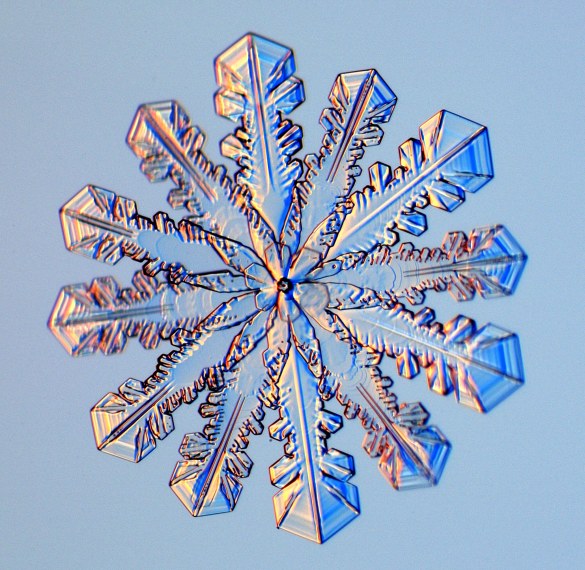
On the Five-Pointed Snowflake


There’s a fun letter in the latest issue of Nature from Thomas Koop at the University of Bielefeld pointing out how often snowflakes in festive decorations, greetings and wrapping paper are misdrawn with fewer or more than six points. Above is a particularly fine example that I discovered this year, in which some of my presents were (ironically) wrapped (available at Sainsbury’s, no doubt now at a reduced price). It never ceases to amaze me that designers have failed to assimilate this very basic fact about the six-pointed snowflake, though it’s been generally known for centuries. Indeed, the knowledge goes much further back than Kepler’s seventeenth-century treatise, as I pointed out here and in the ‘Branches’ volume of my recent trilogy Nature’s Patterns.

(I’m amused too to see that Nature’s marketing folk are still managing to embarrass the scientific staff. I could tell other tales, but it would be cruel.)

Yet these pentagonal snowflakes set me thinking. As is widely known, the only way ‘crystals’ can display growth habits with fivefold (or indeed eightfold) symmetry is if they are in fact quasicrystals. But could water form quasicrystals? Certainly, in the liquid state it is much more congenial for water molecules to form fivefold rings than the sixfold ones present in ice, because the bond angles are then much closer to that preferred in the tetrahedral coordination geometry. And these pentagonal rings are a general feature of the crystal structures of clathrate hydrates, in which water is frozen around nonpolar solutes such as methane. Now, I’m no crystallographer but I have the impression that it would be naïve to imagine that a local pentagonal packing symmetry is all it takes to make quasicrystallinity feasible. But on the other hand, it’s a good start; our current understanding of quasicrystals grew partly out of Charles Frank’s early work on icosahedral clustering in simple liquids. And large icosahedral structures for water have certainly been postulated. In fact, I’m very puzzled that I can seem to find no discussion in the literature of the possibility of quasicrystallinity in water – either I’m failing badly to understand something (quite possible) or I’m somehow looking in the wrong places (also possible). But I will ask my water structure gurus about this, and if anything comes of that, watch this space.

Incidentally, strict twelvefold symmetry is also forbidden in true crystals but known in quasicrystals. Yet a sort of pseudo-twelvefold symmetry has been seen in snowflakes, due to the coalescence of two snowflakes.

Tuesday, December 22, 2009

The transformation of Chartres


 I was interviewed recently by a chap from Die Welt for an article (in German) about the restoration of Chartres Cathedral. This is, for Chartres fans, a very big deal – not only is everything being cleaned up, but the walls are being painted in the original colour scheme of the 13th century, shown above from my book Universe of Stone. The church interior was painted ochre, with while highlights for some of the piers and arches, and a web of white lines picking out false masonry joints. We know this because some of the original paintwork still remains in remote corners of the building.

The result, it’s said, is going to transform the way the interior looks: no longer will it have the purple gloom for which Chartres is famous – one might even say revered. Instead, it will be flooded with light, looking – the claim goes – much closer to the way it did when it was built.

Now, I feel that I should probably be taking an outspoken stance on this – either denouncing the plans as a travesty and desecration, or praising it as a long overdue and wondrous thing. But the truth is that I can too readily see the arguments on both sides.

It is easiest to enumerate those against. It is not lightly that conservators of paintings have reached a consensus that one should not retouch damaged the works of the Old Masters, but should instead aim to prevent or limit further damage while leaving existing blemishes evident. It’s OK, the current view goes, to stick back on flakes of paint that are falling off, but not OK to apply fresh paint. Better to have an honest record of what we have left of these works than to leave us mistaken or confused about what is new and what is original.

What’s more, as I say in the article, it is tempting to imagine that a paint job will enable us to see the cathedral ‘as medieval peasants saw it’. But we need to acknowledge the fact that we can never do that. It’s not just that we will still lack the opulent wall hangings and other accoutrements of ecclesiastical splendour, nor the precise rituals or the social hubbub that conditioned the experience in the thirteenth century. Most crucially, we don’t have thirteenth-century minds. Our entire aesthetic is different, and so is the experience of religious life even for believers today. We enter the Royal Portal from a very different world, already accustomed to light and colour and monumental architecture, even if that is in the form of an office tower. To us – again, even to many Christians – Chartres is basically a tourist destination, and we don’t really have the perception any longer that it is a kind of heaven on earth. Besides, there is no ‘medieval mind’ (despite, I admit, the subtitle of my book) – what nobles, clerics and peasants experienced and believed was considerably different.

This much is true for any kind of antiquated art, of course. The same considerations are rightly said to somewhat undermine a purist attitude towards ‘authentic’ early music: we can do all we like to play it on the ‘original’ instruments, and with the ‘original’ intonation, but we don’t have, and can’t give ourselves, Renaissance ears. The way we hear has been irrevocably ‘contaminated’ – or better to say, altered. Arguably, it is best simply to recognize that and to get on with the business of responding to art from a contemporary standpoint, rather than fooling ourselves that we can experience it ‘as it was originally intended’.

And yet… One could surely argue that, just because we can’t reproduce exactly the experience of people at the time the art was made, that needn’t prevent us from doing what we can to get close to it. It could seem rather condescending to take the attitude that, because the audience is ‘ignorant’, it doesn’t really matter what we place before them. Besides, there is surely a difference between pretending we can paint a hand just like Titian and slapping on some wall paint that, in all probability, was applied in the thirteenth century with not too dissimilar a sensibility to that of builders and interior decorators today (i.e. it’s just another job). And might many visitors already think anyway that what they are seeing at Chartres is what the medieval worshippers saw?

What’s more, conservation of a building like this, exposed to the elements – unlike a painting that can be kept in a protective environment – has to involve a constructive element. Otherwise it wouldn’t last another hundred years. That was very apparent to me when I visited the masons’ yard at York Minster, where stones were constantly being shaped to replace those that were on the point of crumbling away. There is a kind of enforced honesty in this process, as one can very easily distinguish the new, golden blocks from the old soot-stained ones.

Perhaps most importantly of all, we need to get rid of the idea that there was some ‘pristine’ version of the cathedral that, now lost, should forever remain so. A cathedral was almost always a work in progress, and almost always a mutated, even botched or ruined, version of what one or other of the master builders envisaged. As often as not, no sooner had a piece of work been completed than the next bishop would decide he wanted this or that altered. Throughout the centuries, changes were made with no sense of reverence for what had gone before. So what is so bad about another revision today?

On balance, I am somewhat in favour of the restoration work. Not least, I am simply curious, even excited, to see what effect the colour and brightened windows will have, quite aside from arguments about the supposed rights and wrongs of it all. I love Chartres, but I think we’re in trouble if we start to regard the place as untouchable. That was never how a cathedral was meant to be. I think that a restoration like this can be welcomed if it is done in good faith (so to speak), making it clear to visitors that this is indeed new paintwork that represents our best guess at what this particular aspect of the cathedral interior was like at the time of its consecration. Of course, my best recommendation for making sure visitors are well prepared to interpret what they see would be to read Universe of Stone first. But modesty forbids. 

Friday, November 27, 2009

Quantum Objects


[I have a piece in Nature on an art exhibition in the US by Julian Voss-Andreae, who has been working for some time now on representations of ideas, concepts and objects in physics and chemistry. This latest show is called ‘Quantum Objects’, and there are images of it here. I have written previously about Julian’s chemistry-related sculptures. I think Julian’s work is some of the best there is on the sci-art interface, creating a genuine point of confluence rather than, as all too often happens, a kind of awkward shotgun marriage.

In the course of preparing the piece, I had an exchange with Julian about the thinking behind his work, during which he said far more than I could accommodate in the article. This was all good stuff, so I’ve appended his comments below.]

When once asked what his Third ('Eroica') Symphony meant, Beethoven is said to have sat down at the piano and started to play it. Physicists might seek analogous recourse when asked to explain quantum theory – by writing down Schrödinger’s wave equation. And even this was Schrödinger’s attempt to provide a concrete embodiment of the still more abstract ‘description’ in Heisenberg’s austere matrix mechanics. Some of the field’s pioneers concluded that perhaps all we can ever meaningfully hope for by way of representation are the equations.

This implies that any attempt to show quantum concepts using images, whether for experts or non-specialists, is doomed to be misleadingly reductive. But maybe another alternative is to subvert our preconceptions through art. That is the view of Oregon-based sculptor Julian Voss-Andreae. Art, he says, ‘freed nowadays from the presupposition that it needs to visually accurately represent reality, has a unique potential for indicating aspects of reality that science cannot.’

Voss-Andreae is better placed to judge than most artists, for he was previously a physicist working at the forefront of experimental quantum physics at the University of Vienna, where he came face to face with the counter-intuitive aspects of the theory. In 1999 he participated in a ground-breaking experiment showing that even objects as ‘big’ as C60 molecules may display the wavelike property of interference (M. Arndt et al., Nature 401, 680-682; 1999). Voss-Andreae’s portrayals of ‘quantum objects’ are now on display in an exhibition called Worlds Within Worlds, running until April at the American Center for Physics in College Park, Maryland.

‘There simply are no consistent mental images we can create to understand the world as it is portrayed in quantum physics, because our brains are exquisitely adapted to making sense of the world on our scale’, says Voss-Andreae.  ‘I want to increase the audience’s capacity to intuit the unfathomable deeper nature of reality by sensually experiencing the works.’

This attempt to leap beyond the logical is an impulse with an obvious appeal to artists, but Voss-Andreae is not the first to find inspiration in the way that modern physics requires it of us. In the early twentieth century, Surrealist artists such as André Breton and Salvador Dalí were excited by what they saw as the challenge posed by quantum theory and relativity to conventional notions of causality, time, geometry and objectivity (see Gavin Parkinson’s Surrealism, Art and Modern Science; Yale University Press, 2008). Yet their enthusiasm was due as much to the new physics’ perceived radicalism and assault on convention as it was to any genuine interest in the theories, and they didn’t understand the science terribly well.

But who does? Perhaps the biggest problem for any artist seeking to mine quantum theory is that some of the fundamental issues are still not agreed by its practitioners. The disputes about interpretation among the early pioneers such as Einstein, Bohr, Heisenberg and Schrödinger are now legendary (see Manjit Kumar’s Quantum; Icon, 2008), but this by no means implies that they are behind us. The Copenhagen interpretation favoured by Bohr and Heisenberg, with its wave-particle duality, probabilistic picture and observer-induced collapse of the wavefunction is still not universally accepted, and the nature of the transition from quantum to classical behaviour continues to be debated. Meanwhile, the failure to unify quantum theory with gravitation remains one of the most well advertised lacunae in physics, seeming to leave open the possibility that quantum theory is a stop-gap, a mere mathematical convenience.

It’s therefore arguably either brave or foolhardy to try to represent quantum phenomena visually. Perhaps Voss-Andreae’s greatest asset as a former physicist is that he knows how much we don’t know, and how much is contingent. In some of his works, the inverted commas of analogy are explicit to the knowing eye. Quantum Corral materializes something that could hardly be less material: the wavelike properties of electrons (first reported in Nature in 1927). Here they are represented in a block of wood milled to the contours of electron density seen in 1993 around a ring of iron atoms on the surface of copper using a scanning tunnelling microscope. The gilded surface reminds physicists that it is the mobility of surface electrons in the metal which accounts for its reflectivity (and the coloration of gold is itself a relativistic effect of the metal’s massive nuclei). But for art historians, this gilding not only invokes the crown-like haloes of medieval altarpieces but could also allude to the way gold was reserved in the Renaissance for the intangible: the other-worldly light of heaven.


Night Path and Spin Family (Bosons and Fermions), with their webs of metal wire or silk thread in solid steel frames, hark back to the sculptures of Naum Gabo, themselves inspired by the appearance of new mathematical geometries and models. Yet Night Path shows a quantum idea: the path-integral approach to the trajectories of light, in which the passage of a photon is considered to be the integral over all possible paths, calculated by slicing up time. Here, however, Voss-Andreae is not trying to produce a ‘textbook’ representation. ‘I do not show a fixed end point as Feynman’s method demands’, he says. ‘Instead in my piece the paths emerge from one point and then keep opening up. The artwork is not meant to accurately illustrate the technique of path integration; I made it to illustrate the ‘feel’ of it.’ In the Spin Family series, inspired by the quantized spin states of the two classes of fundamental particles, the diaphanous thread allows us to visualize superpositions of states while cautioning against too literal a picture of what ‘spin’ itself represents.

A feeling of intangibility and the subjectivity of points of view pervades Quantum Man, a walking figure created from parallel slices of steel in which the particle-like concreteness seen from the front shifts to wave-like near-invisibility viewed from the side. This sense of an object on the point of disintegrating is a common trope of recent artistic efforts to capture ideas in physics, from Antony Gormley’s Quantum Cloud series to Cornelia Parker’s Cold Dark Matter. Put the pieces together yourself, they seem to say – because that’s how the world works anyway.


Q&A with Julian Voss-Andreae

PB: Do you actually want to give viewers a flavour of the ideas behind the quantum works, or are you simply using the science as a launching point for something more abstract?

J V-A: I do want to give a flavor of the underlying ideas, at least while the sculptures are on display at the American Center for Physics. I am displaying them with explanatory text to alert the audience to the fact that there is a real concept behind each piece. For this show I wanted to make works that physicists can relate to. But I didn’t want to stop there. I am always seeing the physics (or other sciences) as a starting point for creating something that develops its own life as an art object. I want people who don’t have a background in science to enjoy the work as well. I want to increase the audience’s capacity to intuit the unfathomable deeper nature of reality by sensually experiencing the works.
PB: Do you feel that quantum theory is really something that can be, or ought to be, visualized at all? - I guess the answer to that must clearly be 'yes'

J V-A: Well, the way my own mind functions I cannot really grasp anything without images. I have to make images for myself, real ones or in my mind, if they don’t exist. And I believe that this is so for many if not most people. So if you look at any quantum mechanics textbook there are lots of images - especially in books from your culture. In Germany people have often tried to get rid of images [even though they have the word ‘anschaulich’]; there was for example a movement in mathematics, I believe in the 1960s, which banned images altogether from their books because the authors felt it is a flawed practice since every image can always portray only one special case. That is of course true, but most of us still need images. Many of the more complicated things visualized in quantum physics textbooks are clearly illustrations of a single facet of something more complex and more abstract, something that the mathematical description might be able to express in one coherent concept but that we sometimes cannot grasp within one coherent (mental) picture. You are probably familiar with Bernd Thaller’s work: He creates movies of quantum systems, typically of the time evolution of wave functions. Using color value and hue to encode different variables he is able to portray complete wave functions including their phase. It looks beautiful how they move and it is very instructive. So, I definitely think quantum theory can and should be visualized.
PB: But what would you say to the view that any such representation is bound to create an artificially concrete representation of something that is beyond our capacity to intuit?

It has been recognized that quantum theory does not admit of a realistic interpretation. For example, we have no accurate space-time representation of a particle, say an electron:  it is neither a wave nor a particle nor any other “thing”. So there is certainly a danger in presenting artificially concrete representations without making sure they are correctly understood as only a facet of something more complex or altogether different. A well-known example of such a misunderstanding is the ubiquitous hydrogen atom model. There are the earlier models that show electrons as particles orbiting the nucleus in discrete orbits. Then there are the representations of electrons as wave-functions: countless textbooks show the images of s, p, d,… orbitals. [These models often contain an additional imprecision in that they illustrate only the angular dependence of the wave function, and not also the radial one. I am sure there are quite a few scientists who would draw those spherical harmonics if asked ‘what a hydrogen atom looks like’.] But even if the observable electron density is pictured, there still remains a problem, namely the very notion that a hydrogen atom (or any quantum “object”, for that matter), is an object, and has a particular appearance independent of the means used to observe it, or for that matter any objective existence at all. So in the case of the H atom, even if the correct three dimensional shape of the probability density is pictured it is still a potentially misleading abstraction because you need to keep in mind that this shape merely represents tendencies for results of possible electron position measurements, whereas the phenomenal reality it refers to are the discrete and apparently random positions at which the electron is actually measured when an experiment is carried out in which that wave-form represents the prepared state. In fact, there is always a danger of taking any image or model too literally (Whitehead’s “fallacy of misplaced concreteness”). Using images in science or philosophy to illustrate states of affair is therefore quite generally a two-edged sword, and one needs to know the limits of a picture, and use it with discrimination and intelligence.  So with that caution, I would say that art, freed as it is nowadays from the presupposition that it needs to visually accurately represent reality, has a rather unique potential for indicating aspects of reality that science cannot.

In a related vein, I don’t think that a specific piece of art has a single correct “interpretation” (as is true for a textbook image). To me, good art is something that has (by virtue of its sensual and conceptual properties) the potential to give rise to a web of meaningfully interlocking interpretations. So my experimentation ultimately aims at finding (in that sense) ‘good’ art objects. [Btw, it is interesting to relate this to the quantum mechanical measurement process: Art is like an unmeasured wave function with tendencies, a superposition of possibilities (the different interpretations). Then comes the individual’s interpretation of the art work in a specific instance, analogous to the physical measurement that reduces it to one classical answer and forces the system into that state.] 

To further comment on the relationship between my art and the science it relates to:  a piece like “Night Path” (the Feynman paths one) if shown in a textbook, might lead to the misunderstanding that there are a finite number of actual paths to be added. Of course, the number really needs to be infinite to yield the correct result. Moreover, I do not show a fixed end point as Feynman’s method demands; but instead in my piece the paths emerge from one point and then keep opening up. But the art work here is not meant to accurately illustrate the technique of path integration. I made it to illustrate the ‘feel’ of it. I like the idea of having these myriad paths that wiggle around in a completely ‘non-physical’ fashion (i.e. being everywhere at every time) and that they get more and more important in the classical trajectory’s vicinity because there the phase oscillates slower. So I took a Gaussian distribution around a parabola and used the pseudo random generator in the computer to calculate where to make holes into the slices. I followed the output of the algorithm quite strictly because I didn’t want to bias the result with ‘human pseudo randomness’. Before I built the piece I visualized it in the computer to fine-tune the parameters involved (the shape of the trajectory, the sigma of the Gaussian etc.) and that gave me the idea of evoking an image of a meteor falling through the night, which then informed the choice of colors. That is where I allow myself the ‘poetic departure’ from physics. For a textbook, I would not have used a parabola and I would have collected the paths back into a single endpoint. So my hope is to convey this bizarre feeling of the path integral approach (even if it is not recognized as such) by merging it with an image (the meteor) that is known to everyone. I always feel I am experimenting here. Not only with the materials and algorithms etc. but also with having an idea and turning it into a real object to see what it does to me and others. This is where my experimental art work departs from experimental physics: I am ultimately interested in creating an art object, something that strikes a chord in the viewer.

[I think it is key to display the works in an art setting. Even though it is the American Center for Physics in this case, the place where the sculptures are displayed is designated to displaying art and the audience knows that. The same is true for the display on my website.]

[Concerning the wording in your question: Do you mean capacity to intuit or capacity to understand? There are obviously things that are beyond our capacity to understand in the sense that we cannot find a single coherent mental image that provides a complete description of that thing. But maybe we can intuit a solution to a paradox even though we cannot understand it.][PB: I agree, and that’s indeed what I meant: intuition does not necessary imply rigorous understanding, but is perhaps all we can hope for here, especially if one isn’t a specialist.]
PB: I'm also interested in whether there are any artists who provide particular inspiration for you, either from a purely visual point of view or because they have similarly tried to articulate and present rather abstract ideas and phenomena.
J V-A: I am influenced visually by a lot of things in art and architecture. I frequently get ideas from other artists about how to solve problems technically or they give me an idea what could work visually. I don’t have a particular artist that I draw inspiration from when it comes to taking images from science to create art. But on a more abstract level there are artists I greatly admire for the intensity of their work and because they lead the way with their visions and their ability to realize them. There is one artist in particular I feel I have an odd connection with and that is Antony Gormley. It happened several times already that I had an idea and found out later that he had gone in that direction. We are interested in very similar things and he is very systematic and efficient in exploring them. I would love to meet him one day.

PB: Can you also tell me a little about how the exhibition came about?


J V-A: The curator, Sarah Tanguy, had asked me a few years ago if I was interested in showing my work at the American Center for Physics because she thought my work would fit well there. Last year, after she was able to secure the funding, I was supposed to have the show. But after I had thought about it and decided to make all works which had to do with quantum physics, I realized that I needed another year to finish them.


Statement on the website, also displayed at the exhibition (J V-A)
The term “Quantum Object”, although regularly used in physics, is really an oxymoron. An ‘object’ is something that lives completely in the paradigm of classical physics: It has an independent reality in itself, it behaves deterministically, and it has definite physical properties, such as occupying a well-defined spot in time and space. For the ‘quantum’ all those seemingly self-evident truths become false: Its reality is one that is relative to the observer, the principle of causality is violated, and other features of materiality such as clear boundaries in space and time, objective locatedness or even identity, do not pertain.
After struggling with quantum physics for the last hundred years we cannot escape the fact that there simply are no consistent mental images we can create to understand the world as it is portrayed in quantum physics, because our brains are exquisitely adapted to making sense of the world on our scale, as perceived through our unaided senses. My hope is that the unique ability of art to transcend the confines of logic and literal representation and to offer glimpses of something beyond can help us open up to a deeper understanding of the world and to wean ourselves from the powerful grip classical physics has had over the last centuries on our every perception of reality.
General Artist Statement (J V-A)

My diverse interests, investigations and works as both scientist and artist are ultimately derived from my lifelong fascination with Nature. As an observational painter in my youth I was so intrigued by the natural sciences and its philosophical implications, that I subsequently spent the next eight years studying physics at European universities. I earned my degree in physics participating in a seminal experiment at the boundary between quantum physics and philosophy. I then moved to the United States to study art and began developing a body of sculptural work often inspired by scientific themes, such as quantum physics or the structure of protein molecules, the building blocks of life.

I create art by taking something I see or know and translating it into an object. This translation starts out being guided by clearly expressible ideas and tends to develop into something successively complex and less accessible through logic and words. The act of creation contains an extraordinary and most fulfilling aspect I find impossible to understand intellectually: The creative moments are not governed by my conscious thought. On the contrary, it is typically the unconsciously contributed aspects, executed in a certain meditative state of mind that brings the work to life, adding new and often surprising layers of meaning.

It is important for me to create works in a spectrum ranging from mostly intellectual to mostly intuitive in order to generate a cross-inspiration between both approaches. Achieving the right balance of intellect and intuition, of science and art, is central to both my work and my life. In fact, I feel unable to clearly distinguish between the concepts of intellect and intuition, which are commonly perceived as polar opposites, and I strive to unify these opposites into a single more fundamental idea. I am motivated by the desire to create a broader understanding of Nature than the one provided by science alone: My work allows intuiting our world by offering a sensual experience of what is usually accessible only through our intellect.

Wednesday, November 18, 2009

Books of the Decade

Blackwell’s have, in their wisdom, apparently selected Critical Mass as one of their top 100 ‘paperbacks of the decade’ (don’t ask me why they specify paperbacks). Nice. As a result, they asked me to come up with my own selection of three from the past decade – which is not as easy as it sounds (it makes me realise that most of the books I read are older than this). So this is what I offered them:

James Meek’s The People’s Act of Love (Canongate, 2005), while beautifully written and plotted, might not seem an obvious candidate for an outstanding novel of the decade. But it has stayed with me as an exquisite piece of storytelling of the kind that one associates with the best pre-modernist fiction, and makes a compelling imaginative leap into a wholly unfamiliar milieu. Comparisons with Conrad and Dostoevsky were not amiss. It’s not clear whether W. G. Sebald’s Austerlitz (Penguin, 2002) is fiction or not, but it was my introduction to Sebald and to an entirely original and totally hypnotic style of writing. Richard Holmes’ The Age of Wonder (HarperCollins, 2008) is perhaps the only history of science I have read that has been genuinely exciting and inspiring to read, with something to enthral the reader on every page. All of these books have left their mark on my own writing.